
A validator is an essential participant in a Blockchain network that substantiates transactions and sets the seal on the overall integrity and security of the distributed ledger. Its specific role and function are based heavily on the blockchain’s consensus mechanism. The world of decentralized finance and Web3 is underpinned by a censorious, often-unseen infrastructure by Validator Node. These digital sentinels are the pillars of Proof-of-Stake (PoS). Running a high-performance validator is a complex, high-stakes operation that demands precision engineering, robust security, and deep financial commitment.
Upcoming Project
Validators can launch and sculpt the governance of its chosen network, and a growing number of forward-thinking corporations are recognizing their strategic value.
EAZE IT Runs Cosmos Validators and Ethereum
The Cosmos ecosystem is powered by the Formerly Tendermint, ComeBFT, a complete node, which is powered by the CometBFT (formerly Tendermint) consensus engine, a validator is a network participant who runs a full node and is supervised to perpetrate latest blocks to the blockchain. The total volume of staking tokens (as ATOM on the Cosmos Hub) is the core of validators. An integration of the both entities first one is self-delegation is known as its own staked token, second one is token holders are known as delegators. Their supremacy in the network, or voting power, is straightforwardly equivalent to this total staked amount.
EAZE IT Runs Ethereum Validators
An Ethereum validator is a virtual entity on the network constructed by an ETH holder who handpicks to stake a fixed quantity of Ether. This staked ETH behaves as collateral, admitting the validator the principle to propose and attest to blocks. The transition to proof-of-Stake (PoS) with the Merge. Ethereum (ETH) presently relies thoroughly on a decentralized network of Validators to secure the network, transactions acts, and mint new blocks. These participants are the foundation of the consensus mechanism, certify the integrity and robustness of the world’s leading smart contract platform.
Blockchain Timeline
It’s an ambitious plan to launch our own dedicated validator node within the next timeline.
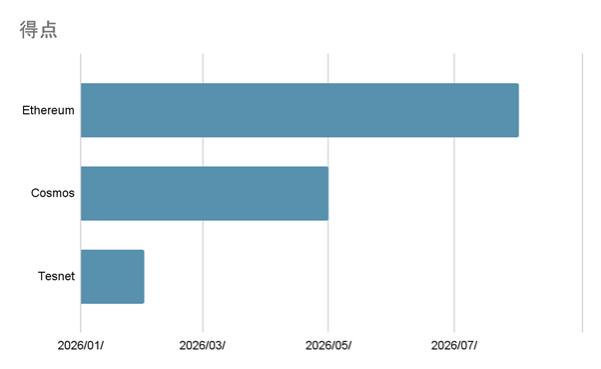
EAZE IT Japan and Bangladesh’s both organizations are dedicated for the run of the Validator. The following aspects concentrate the top level hierarchy of the engineering and managing consortium.

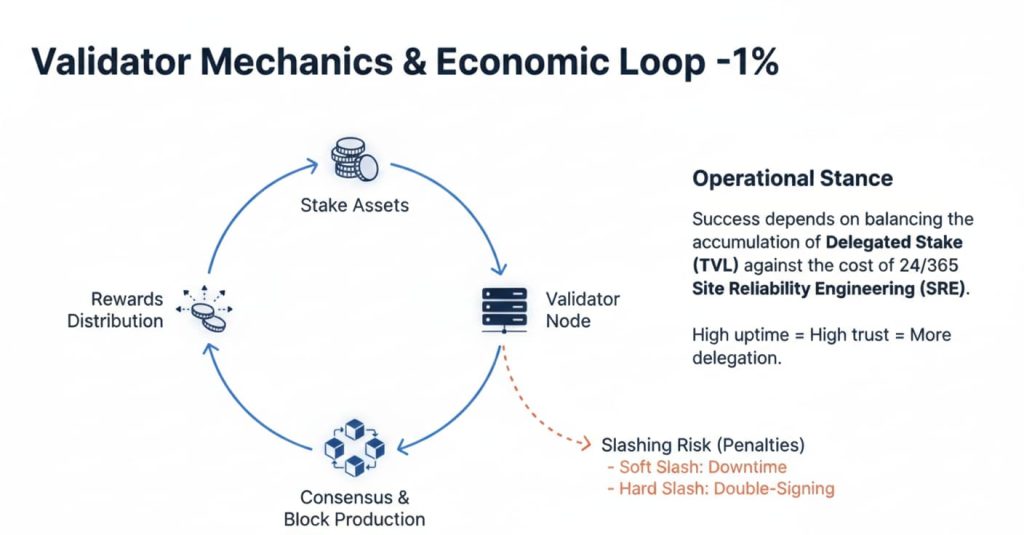
EAZE Validator Mechanics and Economic Lifecycle
The core operational and economic lifecycle of the EAZE Validator, emphasizing a continuous feedback loop designed to maintain network integrity and investor confidence. At the start of the cycle, users provide the necessary capital by choosing to Stake Assets, which serves as the fundamental fuel for the validator’s participation in the network. These assets are directed toward the Validator Node, which represents the technical infrastructure managed by EAZE. The success of this node is deeply tied to our Operational Stance, where the primary objective is to maximize the accumulation of Delegated Stake (Total Value Locked). This is achieved by balancing the significant overhead costs of 24/365 Site Reliability Engineering against the performance of the node, as maintaining high uptime directly translates into higher trust and more delegation from the community.
Once the node is active, it moves into the phase of Consensus and Block Production, where the validator actively secures the blockchain by validating transactions and proposing new blocks. This consistent performance leads to Rewards Distribution, where the incentives generated by the network are shared back with the stakeholders, completing the primary economic loop. However, the diagram also highlights the critical Slashing Risks that act as a deterrent against poor performance or malicious intent. Under the EAZE framework, technical failures like downtime result in a Soft Slash, while more severe violations like double-signing lead to a Hard Slash. By managing these risks effectively through superior engineering, EAZE ensures the loop remains profitable and secure for all participants.
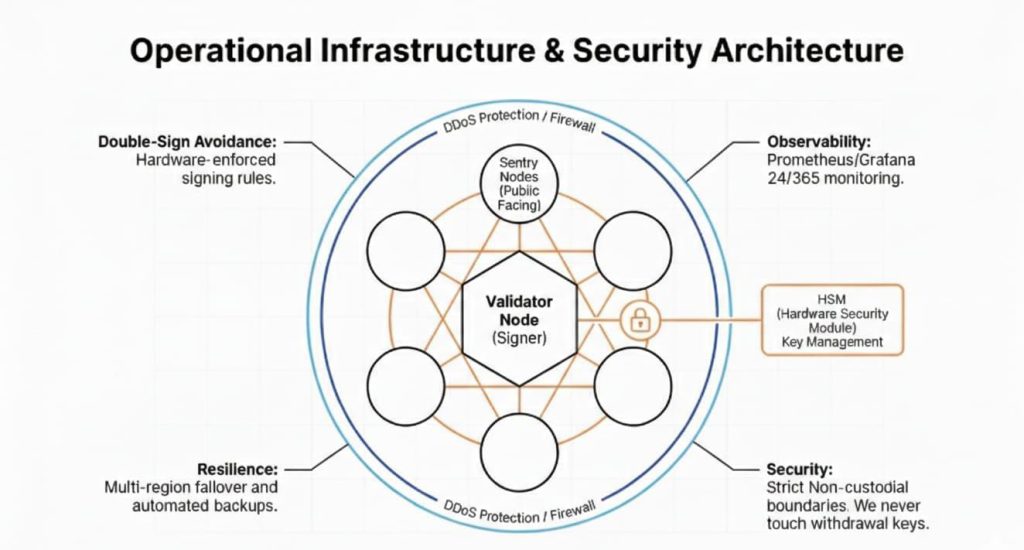
Operational Infrastructure and Security Architecture
Our production-ready Operational Infrastructure & Security Architecture clearly highlights the “defense-in-depth” layers that protect our delegators’ assets.
The architecture centers on the Validator Node (Signer), which is the heart of our staking operation. Surrounding it are several Sentry Nodes, which act as a public-facing shield. This specific design ensures that the Validator Node remains hidden from the public internet, mitigating the risk of direct attacks. The blue circular rings represent our DDoS Protection and Firewall layers, which filter incoming traffic before it ever reaches our internal sentry network. Key security features highlighted in this clean version include:
Double-Sign Avoidance: We utilize hardware-enforced signing rules to ensure that the EAZE validator never signs two blocks at the same height, protecting the stake from being slashed.
HSM Key Management: All private keys are managed within a Hardware Security Module (HSM), ensuring they are never stored in a way that could be exposed to the network.
Observability & Resilience: Our team maintains 24/365 monitoring via Prometheus and Grafana, while our multi-region failover strategy ensures that the validator stays online even during a regional data center outage.
Non-custodial Security: This diagram reinforces our commitment to safety; we never touch withdrawal keys, ensuring that delegators always maintain ultimate control over their funds.
This streamlined visual is intended for our technical documentation and stakeholder presentations to demonstrate the enterprise-grade security we provide.
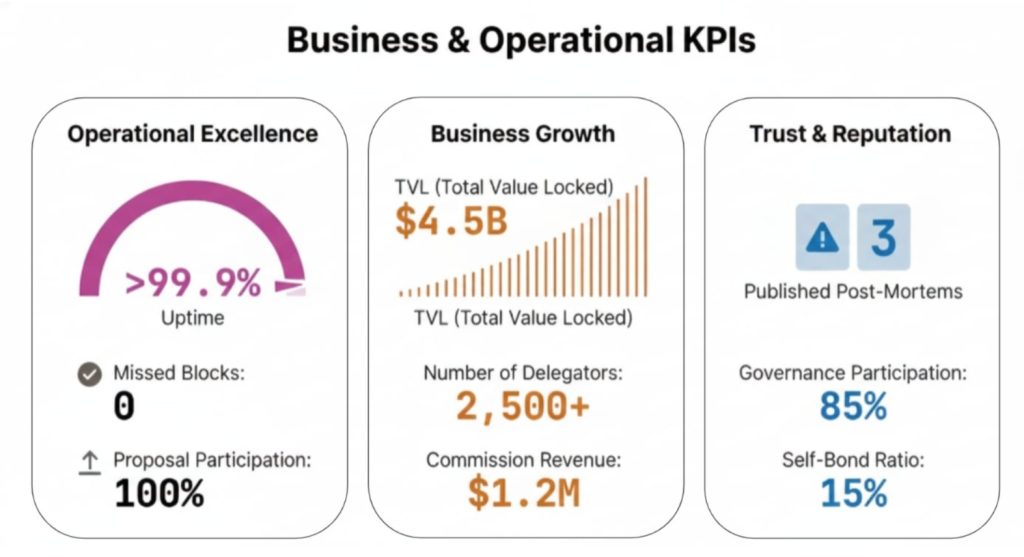
Business and Operationation KPI
Business & Operational KPIs, which serves as a comprehensive performance overview for a blockchain validator or node operator. The data is categorized into three strategic pillars: Operational Excellence, Business Growth, and Trust & Reputation. Under Operational Excellence, the dashboard highlights a high level of technical reliability with a network uptime exceeding 99.9%, zero missed blocks, and a perfect 100% proposal participation rate, indicating that the node is consistently active and contributing to the network’s consensus mechanism without failure. This is critical in a blockchain context as high uptime and proposal participation ensure the stability of the ledger and maximize rewards for stakeholders.
In the center, the Business Growth section focuses on economic metrics, showing a Total Value Locked (TVL) of $4.5 billion with a clear upward-trending bar chart. This suggests significant market confidence and liquidity within the validator’s ecosystem. The validator has attracted over 2,500 delegators, resulting in $1.2 million in commission revenue, which illustrates the scale of its operations and its ability to monetize the trust of its community. Finally, the Trust & Reputation column addresses transparency and community involvement, showing 3 published post-mortems to explain past incidents, an 85% governance participation rate that reflects active engagement in protocol decision-making, and a 15% self-bond ratio, which indicates that the operator has “skin in the game” by staking their own assets alongside those of their delegators.
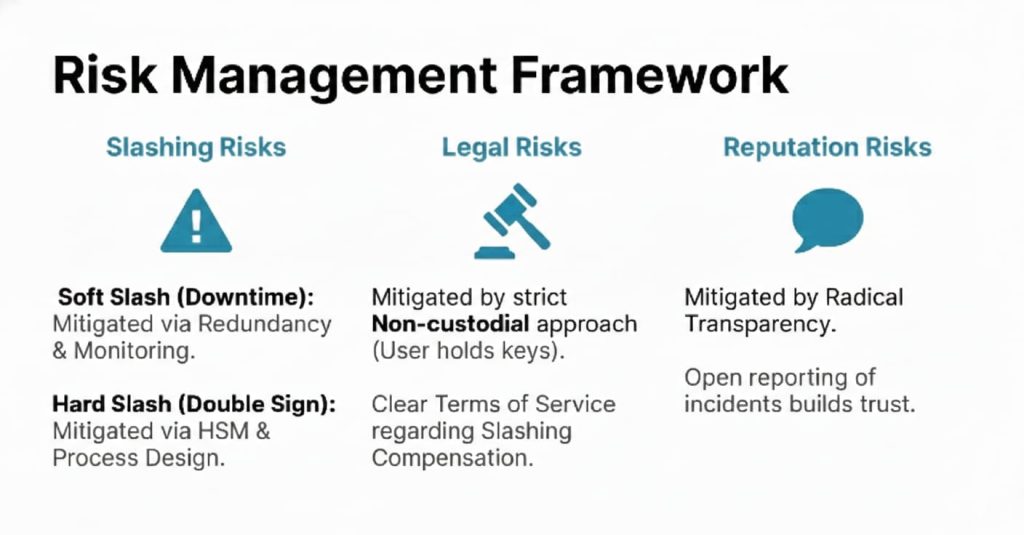
Risk management Framewrok
The provided Risk Management Framework for EAZE Validator Japan outlines a comprehensive strategy for maintaining the integrity and reliability of their staking operations through three core pillars: Slashing Risks, Legal Risks, and Reputation Risks. To address technical vulnerabilities, the framework distinguishes between soft slashing caused by downtime and hard slashing resulting from double signing, utilizing high-level redundancy, constant monitoring, and Hardware Security Modules (HSM) to safeguard delegator assets. Legal compliance is centered on a strictly non-custodial architecture where users maintain control of their private keys, supported by clear contractual terms regarding compensation protocols. Furthermore, the validator reinforces institutional trust through a commitment to radical transparency, ensuring that all operational incidents are reported openly to the community to maintain a strong and dependable reputation within the Japanese blockchain ecosystem.
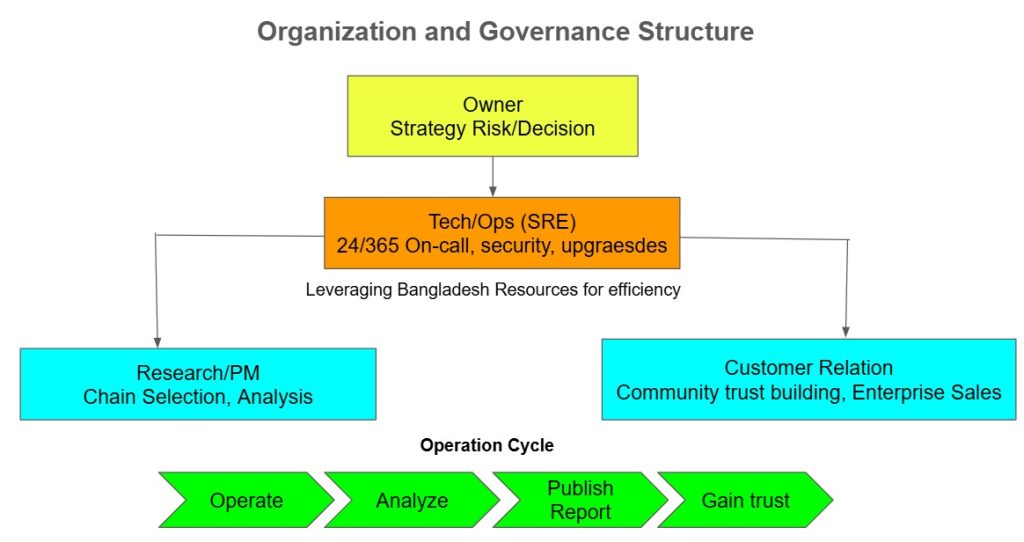
Organization and Governance Structure
a comprehensive Organization and Governance Structure designed to support the EAZE Validator’s mission of maintaining a secure and efficient network presence. At the top of the hierarchy is the Owner, who is responsible for high-level strategy, risk management, and critical decision-making to ensure the long-term viability of the validator. Directly reporting to the owner is the Tech/Ops team, functioning as Site Reliability Engineers (SRE) who manage the core infrastructure with a 24/365 on-call rotation, focusing on security and system upgrades. This technical layer is notably supported by leveraging resources in Bangladesh to maximize operational efficiency.
The technical core feeds into two specialized branches: Research/PM and Customer Relations. The Research/PM department focuses on chain selection and data analysis to determine where the validator can provide the most value, while the Customer Relation team handles community trust-building and enterprise sales to grow the validator’s influence. This entire structure is unified by a continuous Operation Cycle depicted at the bottom of the chart. The cycle moves fluidly from operating the infrastructure to analyzing performance, which then leads to publishing transparent reports. These published results ultimately culminate in gaining trust from the community, creating a feedback loop that reinforces the validator’s reputation and operational excellence
White Level Project
Our staking is mainly piloting the comprehensive footstep for guiding the mechanism regarding the choose and select desired wallet and also narrate the documentation and solution for the custodial wallates. All the inquiries regarding staking methodology also provide the feasible solution by the personnel.
For collaborating more white level project, social media marketing, Sales operation please contact with Eaze IT.
How Can We Support You?
Reach out to our EAZE IT team anytime or send us your inquiry online — we’re here 24/7 to assist with your IT needs.
“At EAZE-IT, we see technology as a bridge to growth and innovation. By combining precision with creativity, our team delivers reliable, future-ready solutions that help clients stay ahead in a fast-changing digital world.”
